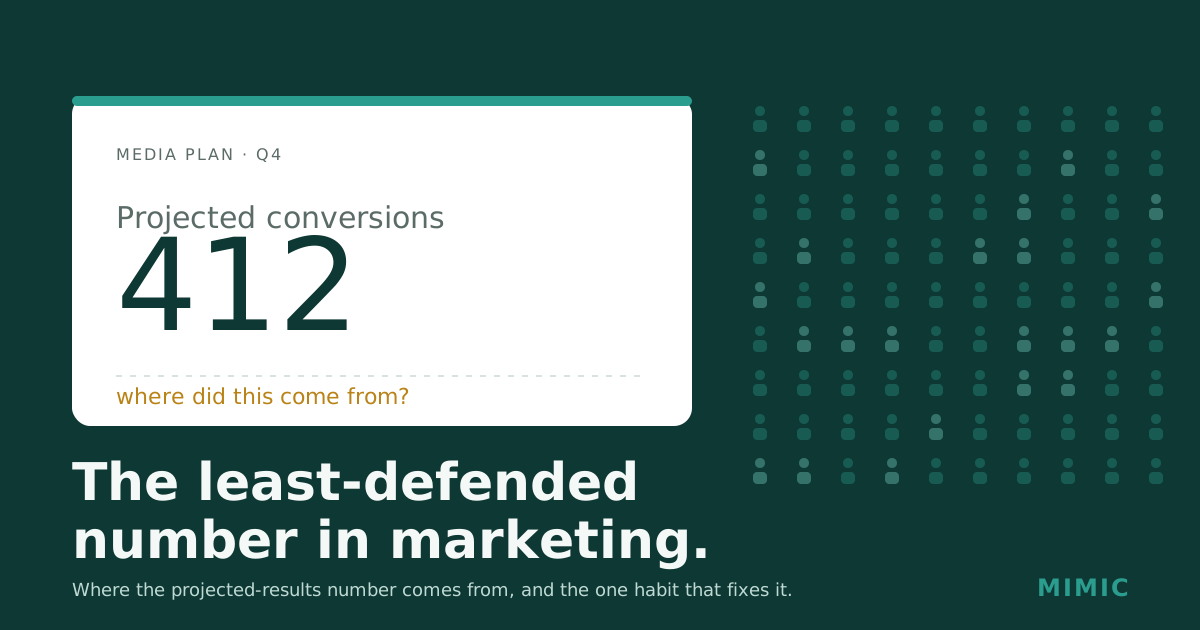
Every media plan has a slide with a projected result on it, a conversion count, ROAS figure, and a reach figure with one decimal place.
I have sat in a lot of rooms where that slide came up. Someone always asks where the number came from. The answer is a shrug with a benchmark attached.
That is worth stopping on. The number is the reason the plan gets approved. And nobody checks it.
How the number usually gets made
I am not guessing here. I have made this slide. This is the process, in order.
- Someone asks for a projection. The plan is due Thursday.
- You pull last quarter's CTR and conversion rate from the platform. If this client has no history, you use a published benchmark for the category.
- You multiply budget by an assumed CPM to get impressions. Impressions by CTR to get clicks. Clicks by conversion rate to get conversions.
- The CTR is a range, not a number. You pick a value inside it that you can defend, and you move on. Thursday.
- You put the result on the slide. The CPM you assumed, the benchmark you leaned on, and the value you picked stay in the spreadsheet.
Step 5 is the problem. Not the arithmetic. The arithmetic is fine. The problem is that three decisions went into the number and none of them are visible.
Why nobody asks
The client doesn't ask because they assume you know and asking feels like an accusation.
The CMO doesn't ask because the number is the size they wanted. If it were smaller, they would ask.
So the number gets copied into a forecast deck and gets used to judge the campaign later. When the campaign misses, everyone argues about the campaign. Nobody argues about the number, because the number has no visible parts to argue about.
The client asks once, hears "benchmark," and moves on. Pressing further feels like an accusation.
The CMO does not press because the number is the size they wanted. If it were smaller, they would.
You do not volunteer the rest because the slide has no place for it. One number fits a slide. Four assumptions do not, so they stay in the spreadsheet, and Thursday arrives.
The missing parts are the problem, not the number
A projection is a set of assumptions run through some arithmetic. That is all it is. That is all it can be. Nobody has real data about a campaign that has not run.
So a projection is not wrong for being an estimate. Every projection is an estimate. A projection is wrong when it hides that it is an estimate, and hides what it is an estimate of.
Compare these two slides.
Slide A: "Projected conversions: 412."
Slide B: "Projected conversions: 412. Estimate. Assumes $8.40 CPM, 0.9% CTR, 3.1% conversion rate. CTR taken from Q2 campaign for a similar audience. Conversion rate is our starting assumption for a new landing page; no history yet.
Slide B has the same number. It is a much better slide. Here is why.
The client can now argue with the right thing. They might say the landing page will convert better than 3.1%, because they have data on it. Good. Change the assumption. The number moves. Everyone can see why it moved.
When the campaign runs, you can check each assumption on its own. Maybe the CPM was right and the CTR was low. Now you know what to fix. With Slide A, you know only that 412 did not happen.
And you stop defending a number. You start defending assumptions. Assumptions are defensible. They are things you believed, for reasons you can state. A bare number is not defensible. It is just a claim.
One habit
Print the assumptions next to the number.
That is the habit, and it costs one extra line on the slide. It is uncomfortable the first time, because it shows how much of any number is a decision. That discomfort is the point. Every number in every plan was built the same way. Slide B admits that decisions were made and slide A does not.
What this habit does for you over time:
- Your projections get better, because you can see which assumptions were wrong.
- Your clients trust the numbers more, not less. A labeled estimate reads as honest. An unlabeled one reads as a sales figure.
- Post-campaign reviews get shorter. You compare the assumptions to actual, line by line, and you are done.
- You stop defending a number. You start showing your work, and people stop arguing with you about it.
Where this goes
I build a product called Mimic. It runs a campaign against a simulated population before you spend anything. You give it the plan: audiences, channels, creatives in the order you would run them, budget, dates. It shows you what that plan produces, as an estimate, before a dollar goes out. Change the plan and the forecast changes, and you can see what moved it. That is not a feature we added. It is the reason the product exists.
But you do not need Mimic to start. You need one more line on the slide. Write down what you assumed. Then let people argue with that.
Mimic runs the plan before you commit to the number. $50/month, first week free.